20 years ago, in August 2005, Hurricane Katrina swept across the Gulf Coast of the United States. One of the worst natural disasters in the country’s history hit New Orleans especially hard. Katrina was a very strong hurricane, and when it hit land, powerful winds and water masses broke through dams that were supposed to protect the city. The result was massive flooding and destruction.
More than 1,800 people died, and hundreds of thousands lost their homes. Whole neighbourhoods were destroyed, leaving many people without shelter or basic supplies. Many people had to wait days for help.
The cost of the damage was enormous—over $100 billion. The storm showed how unprepared the country was in coping with such disasters. Especially poorer communities suffered the most.
Now, two decades later, the memory of Hurricane Katrina still affects the way cities plan for emergencies. New Orleans has been rebuilt in many ways. The city spent billions improving levees and flood walls to protect its inhabitants from future storms. Many neighbourhoods got new homes, schools, and hospitals. Today, communities are working together to make New Orleans better prepared for such catastrophes.
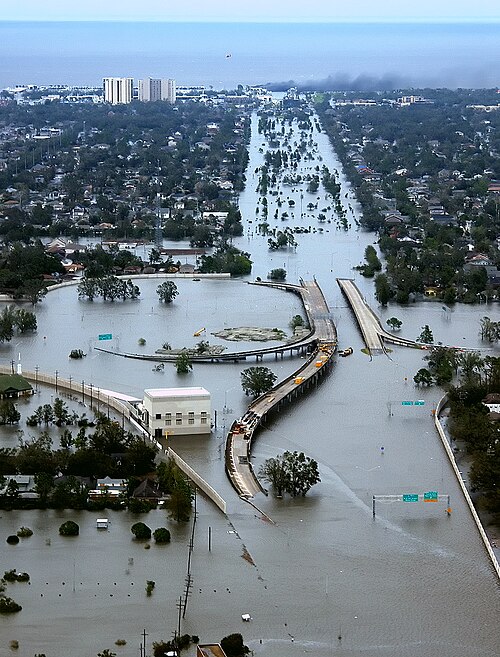
Flooding of New Orleans
Image: U.S. Coast Guard, Petty Officer 2nd Class Kyle Niemi, Public Domain
Words
- basic supplies = everyday things that you need, like food, clothes, medicine etc..
- billion = a thousand million = 1,000,000,000
- community = neighbourhood
- cope with = deal with
- decade = a period of ten years
- destruction = when something is completely damaged so that it cannot be used any more
- emergency = an unexpected or dangerous situation
- enormous = very large
- especially = above all
- inhabitants = the people who live there
- levee = a special wall built to stop water from getting in
- massive = very large, strong
- protect = to keep something safe
- shelter = a place to live
- sweep – swept = here: move quickly from one place to another